
Dunmoochin
Landcare Group
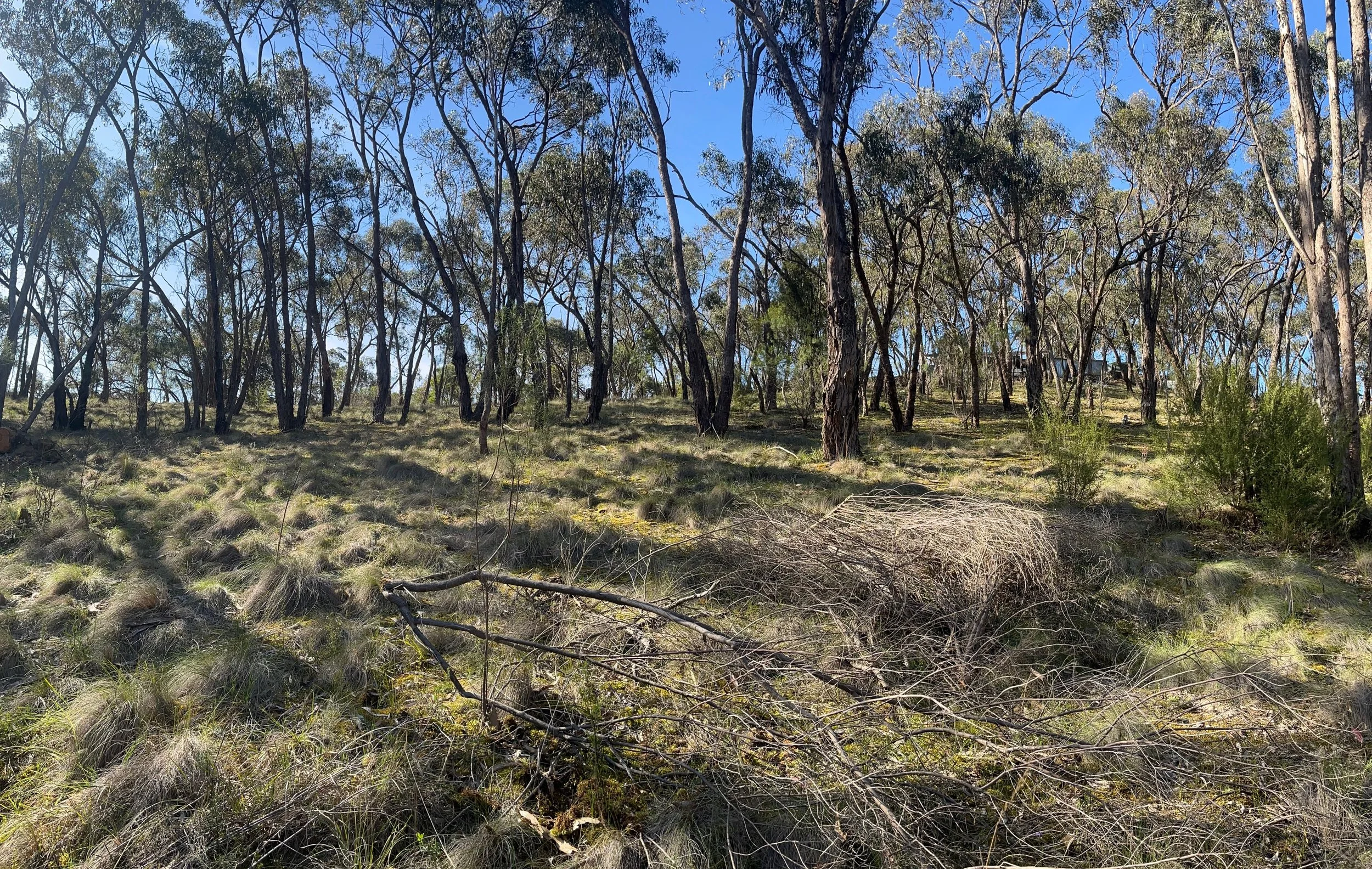
Amazing flora and fauna found in Dunmoochin
Wallflower Orchid
Wallflower orchids (Diuris orientis) are becoming increasingly rare in the shire. We currently know of only three populations across two blocks in Dunmoochin.
This species of Diuris flowers later than the Leopard Orchid. As with the Leopard Orchid, Diuris orientis deceives bee pollinators by resembling indigenous pea shrubs with similar colours. However, the pollinators receive no nectar from Diuris species.
Dillwynia phylicoides
A Dillwynia phylicoides specimen flowering well within an enclosure in Dunmoochin.
This plant seems to be less common here than D. cinerascens, partly because D. phylicoides is less resilient to deer predation and often dies under heavy browsing.
Enclosures now seem to be the only way to ensure good diversity of indigenous pea shrubs in Nillumbik in 2025. May governments get their act together and reduce deer populations across Victoria. Not an easy task, given we are dealing with 200+ kg animals that find ample cover in gullies and among weedy shrubs such as Cassinia sifton.
Protected Orchid Habitat
In this spectacular grassy dry forest patch, Sun Orchids and Caladenia parva specimens can flower en masse, depending on the spring and summer conditions.
Dunmoochin Landcare made cages out of metal mesh purchased from a hardware store (zoom in on the picture). These cages prevent White-winged Choughs from digging up bulbs and deer from trampling the orchids.
Unfortunately, not all orchids and indigenous herbaceous plants can be caged in this patch, which is about 60 × 30 metres. It really does deserve a predator-proof enclosure, and we are working towards securing funding for it.
Leopard Orchid
Donkey Orchid / Leopard Orchid (Diuris pardina) does an impressive job of resembling the flowers of several pea shrubs in Dunmoochin, including Narrow-leaf Bitter-pea and Dilwynia cinerascens.
Bees such as species in the Trichocolletes genus are tricked into pollinating this orchid by assuming it is a pea species rich in nectar. But the orchid does, in fact, not have a nectar treat for the bee.
During this deception, pollen is dislodged and later transferred to another Leopard Orchid, completing pollination. It is important that the Leopard Orchid flowers at the same time as at least one native pea shrub in the area.
Otherwise, this ecological relationship breaks down. After all, the bees still need real nectar and pollen to fly and produce offspring!
Wine-lipped Spider-orchid
A Wine-lipped Spider-orchid flowering in one of our enclosures at Dunmoochin.
This species is listed as Critically Endangered under the Victorian Flora and Fauna Guarantee (FFGA) Act. Hairs on the sepals and stalk give off chemicals that mimic the sex pheromones of female thynnid wasps which attract male wasps.
These wasps pseudocopulate with the flower and, in doing so, pollinate the Wine-lipped Spider-orchid.
Orchid Cages
Tip shops or rummaging through sheds can unveil different materials that can be used for orchid cages. This old hanging basket is a great example.
It allowed one Caladenia parva specimen to flower, while another individual in the picture has gone to seed.
Recruitment of C. parva has at least doubled over one year on a block in Dunmoochin since caging began.
Rosy Hyacinth-orchid
The Fantastic Rosy Hyacinth-orchid. This genus flowers from mid to late summer in Melbourne.
When most orchid species have finished showing off their magical flowers, colours, and designs, we can still enjoy orchid sightings by coming across this species during our surveys or walks in the area.
Orchids in this genus do not have leaves and are said not to produce chlorophyll. They obtain most of their nutrients by connecting with mycorrhizal fungi in the soil.
This seems challenging to understand, as mycorrhizal fungi usually require something in return—typically carbohydrate sugars from plants. But Hyacinth-orchids don’t provide this.
Instead, it appears to be an interesting three-way relationship: the fungus is supported by plants such as eucalypts, and the Hyacinth-orchid benefits through this indirect connection.
Brown's Wattle
This wonderful shrub is called Acacia brownii. I very rarely see a remnant population of this species growing in the wild in Nillumbik, so I was stoked to find six individuals growing in close proximity to each other during a survey in Dunmoochin.
In the near future, we will protect this population with a small chicken-wire enclosure. Within enclosures in Dunmoochin, we have also planted this species to provide food for indigenous wasp and bee species.
Rattlepod Moth
Recently I spotted a day-flying moth feeding on Dilwynia cinerascens in the Dunmoochin Foundation enclosure. I believe it is a Rattlepod Moth. It’s unusual to see moths feeding on pea shrubs.
This is another sign that protection from predators allows plants to flower, which in turn provides food for important indigenous animals in the Mooch.
Matted Bush-pea
Pultenaea pedunculata is a wonderful prostrate flowering pea that, without predation, would carpet many understorey patches within Nillumbik forests.
Native bees, many of which can access the pea flowers, love this plant. As this photo from Dunmoochin shows, without protection it cannot thrive. However, the photo also highlights the value of cages.
In the current ecological state of Nillumbik, cages and enclosures are necessary to protect not only flora but also the native fauna that depend on them for food.
Twining Fringe-lily
What a special little plant the Twining Fringe-lily is!
From its sparkling colours to the frilly petal edges, to its ability to twine up old Red-anther Wallaby Grass stalks—it’s always a treat to see this plant on Dunmoochin blocks.
Indigenous Insects
At Dunmoochin Landcare, one of our main conservation objectives is to promote indigenous insect richness and abundance. We do this through careful selection of which plants to protect and plant in the landscape.
Pea shrubs and understorey herbaceous plants such as lilies and daisies, when healthy, provide an abundance of food for indigenous insects. These insects, in turn, provide wonderful services for our community such as pollination, and they also serve as food for the many insectivorous birds we love hearing in the landscape. An often-forgotten service is the role of predatory insects in controlling smaller insect populations before they get out of hand.
The insect pictured on this Dillwynia phylicoides plant is a robber fly from the genus Daptolestes (family Asilidae). Robber flies are predatory insects often mistaken for large wasps or bees. They are important ecological players, helping to regulate insect populations and maintain balance in the ecosystem.
Imperial Hairstreak
This Imperial Hairstreak is clinging to a struggling Golden Wattle plant. Acacia species are favoured just as much as pea shrubs as a tasty treat by Sambar Deer.
Interestingly, this can sometimes be beneficial for Hairstreak butterflies, as they prefer to lay their eggs on debilitated Acacia species. Presumably this is because the caterpillars can feed more easily when the plant’s defences are weakened.
Keep an eye out in spring and summer for these wonderful butterflies when you come across small Acacia species that are barely hanging on!
Caladenia catarnarta
This magical orchid is called Caladenia catarnarta. It has a much larger flowerhead than Caladenia carnea or C. fuscata, which it can be confused with.
While common in parts of Victoria such as East Gippsland, it is considered rare in Greater Melbourne. Orchid expert and ecologist Karl Just has suggested that the largest population of this species may exist on a block in Dunmoochin.
After hearing this, we promptly created a 30 × 20 metre enclosure to protect the species from deer and other threats.
Flowering populations, like many orchids—particularly Caladenia species—have plummeted in recent years. Although we once had over 100 flowering individuals, in 2025 we counted just 14 flowering.
Slender Stylewort
Always worth spending time looking for small herbaceous plants in the understorey — especially in the compacted Silurian soils of Nillumbik, where small indigenous herbs might be flowering.
This plant is Levenhookia dubia, recorded on a Dunmoochin block right next to an old MG racing track. The soil there is compacted and relatively free of overstorey cover, providing ideal conditions for this species.
Levenhookia are in the same family as the trigger plants (Stylidiaceae).
Rosella Spider Orchid
The Rosella Spider Orchid is listed as Critically Endangered under the EPBC Act, with very few populations remaining in the wild. Dunmoochin Landcare received a grant a few years ago to build an enclosure around this orchid population to manage predation from deer.
As part of our conservation management efforts for this endangered species, we planted shrubs within the enclosure to attract its Leioproctus bee pollinator, including Pultenaea gunnii and the scrambling shrub Hardenbergia violacea. These early-flowering pea shrubs begin blooming in late July to August, which is critically important because this coincides with the flowering period of the Rosella Spider Orchid and the emergence of the Leioproctus bee.
Early-flowering Acacia species, such as Golden Wattle (Acacia pycnantha) and Acacia genistifolia, should also be planted and protected to provide pollen for the female bees. The pollen and nectar are then regurgitated for the bee larvae to feed on, allowing them to develop and continue the next cycle of pollinator offspring. All four elements of this relationship need to be in sync for the Rosella Spider Orchid to be naturally pollinated.
As you can see in this photo, a cage also needs to be placed over rare orchid specimens, as choughs have an insatiable appetite for bulbs. There are currently high numbers of White-winged Choughs in the Dunmoochin area.
Flat-disc Daisies
Check out these flat-disc daisies in the Leporhynchos genus. They're not a common plant in Dunmoochin, but you can find them on southern or east-facing slopes.
Their colour, shape, and the patterns on their sepals are truly remarkable.
Education
Educating ourselves and our community on the needs of our flora and fauna.
Empowerment
Empowering our community to protect the values of our land with shared knowledge.
Protecting Future
Protecting biodiversity values for future generations
Statement of Purpose
Our mission is to protect and enhance the natural ecosystems in the Dunmoochin area. This is achieved by our passionate volunteers dedicating time and resources to understanding the local flora and fauna, conserving habitat for native animals, and reducing the impact of pest and weed species.